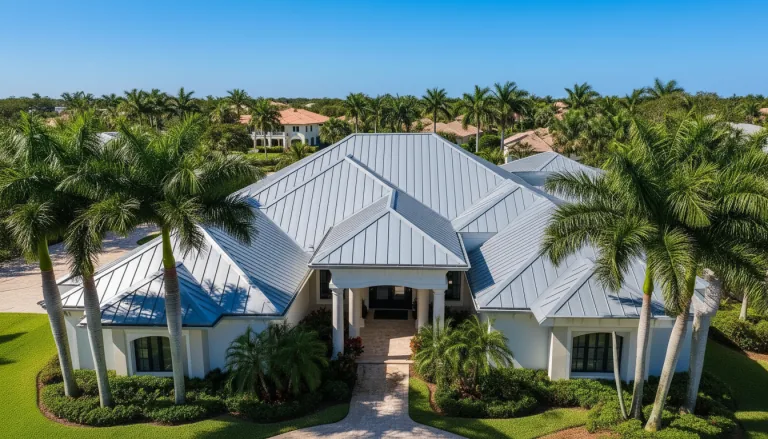
Port Charlotte has a large inventory of older single-family homes and a coastal wind exposure that punishes weak flashing and marginal fastening. O’Brien Contracting handles repair, replacement, inspections and post-storm response throughout Port Charlotte and Charlotte County.
Services in Port Charlotte
Leak and storm-damage roof repair
Shingle, metal and tile roof replacement permitted through Charlotte County
Emergency tarping and damage documentation
Roof condition inspections for insurance renewal
Port Charlotte neighborhoods we work in
Port Charlotte is a large unincorporated community, and the roofs change street by street — from 1960s and 1970s block homes on the original General Development Corporation grid to canal-front properties off the Peace River and newer construction out toward Murdock and West Port.
Murdock & the Tamiami Trail corridor — The commercial spine of Port Charlotte with mixed residential behind it. Older shingle roofs and a lot of low-slope additions tied into pitched sections — the tie-in flashing is usually where the leak starts.
West Port & Centennial Park area — Newer construction on the west side. Roofs are still young, so the common calls are wind-lifted shingles, ridge vent damage and warranty-adjacent repair rather than full replacement.
Harbour Heights — Peace River frontage on the northeast side. Salt-influenced humid air plus direct river exposure accelerates fastener and drip-edge corrosion long before the covering itself gives out.
Grassy Point & El Jobean — Waterfront and near-water lots on the southwest side with open fetch off the Myakka. Wind uplift at the perimeter and corner zones is the design issue here, so fastening pattern matters more than material choice.
Deep Creek — Deed-restricted community across the river in Punta Gorda's postal area but firmly part of the local market. Tile and shingle mix with HOA colour and profile approval required before material is ordered.
Port Charlotte Beach & Edgewater Drive — Canal-front homes with boat lifts and tight side yards. Access and debris control shape the job plan, and salt exposure means stainless or coated fasteners rather than the standard spec.
Kings Highway & Sandhill Boulevard corridor — Established 1980s and 1990s single-family stock. Most of these roofs are on their second covering, which means the deck needs checking at tear-off rather than assuming.
South Gulf Cove & Gulf Cove — Far southwest Charlotte County, heavily hit in 2022 and still working through repair and replacement. Long open lots, high wind exposure and plenty of metal roof conversions.
Charlotte Harbor & Bayshore Live Oak area — Older waterfront homes north of the bridge with mature canopy. Shaded slopes hold moisture, valleys clog and algae streaking shows up years before the roof is actually finished.
Rotonda West & Placida side — Circular deed-restricted layout heading toward the coast. Tile underlayment replacement is the dominant major project, and HOA submittals are part of every job.
Why the neighborhood changes the roof in Port Charlotte
A canal-front home on Edgewater Drive and a 1970s block home off Kings Highway are two different jobs — different fastener spec, different access, different paperwork. Tell us your cross streets when you call and we will tell you what we usually find in that pocket of Port Charlotte.
Frequently asked questions
Which Port Charlotte neighborhoods do you cover?
All of them, including Murdock & the Tamiami Trail corridor, West Port & Centennial Park area, Harbour Heights, Grassy Point & El Jobean, Deep Creek, Port Charlotte Beach & Edgewater Drive, Kings Highway & Sandhill Boulevard corridor, South Gulf Cove & Gulf Cove, Charlotte Harbor & Bayshore Live Oak area, Rotonda West & Placida side.
Do you work in Charlotte County generally?
Yes — Port Charlotte, Punta Gorda, Englewood and the surrounding unincorporated areas.
Can you document damage for my insurer?
Yes. We provide dated photos and a written scope. Approval remains the carrier’s decision.